Foreign national remortgage process UK: 2026 guide

The foreign national remortgage process in the UK enables eligible non-British residents to refinance their UK property under specific lending criteria set by mainstream and specialist lenders. Until recently, many foreign nationals assumed remortgaging was out of reach, but 2026 has brought meaningful changes. Lenders including Hodge Bank and Santander have expanded their criteria, making UK mortgage options for foreigners more accessible than at any point in recent years. Understanding the current rules around visa status, residency duration, and income verification is the difference between a smooth application and an unnecessary rejection.
What eligibility criteria do foreign nationals need for UK remortgaging?
Eligibility for the foreign national remortgage process in the UK centres on four factors: residency duration, visa validity, income verification, and deposit size. Meeting these criteria does not guarantee approval, but failing any one of them will almost certainly end an application early.
Residency duration is the starting point. Mainstream lenders typically require a minimum of 12 months UK residency at the point of application. Some specialist lenders will consider shorter periods, but 12 months is the standard benchmark you should plan around.

Visa validity matters just as much as residency length. Most lenders want to see at least 12 to 24 months remaining on your visa at the time of application. The type of visa also influences which lenders will consider you. Skilled Worker visas and Indefinite Leave to Remain carry the most weight. Student visas and short-term visitor visas are generally not accepted.
Income verification is where foreign nationals often face the most friction. If you earn in a foreign currency, lenders apply a discount to your stated income before calculating affordability. Foreign income recognition often involves haircuts of up to 15% for major currencies, with larger discounts applied to emerging market currencies. That means your actual borrowing capacity may be lower than you expect.
Deposit and LTV requirements have improved significantly in 2026. Hodge Bank now lends up to 95% LTV for eligible foreign nationals, with a residency requirement of just one year and no minimum income threshold. Santander raised its maximum to 90% LTV for applicants with over one year of UK residency and income above £50,000 (single) or £75,000 (joint). These are meaningful shifts from the 75% LTV ceiling that was common just a few years ago.
- Minimum 12 months UK residency (some lenders accept less)
- Visa with at least 12–24 months remaining at application
- UK current account and demonstrable UK credit history
- Income evidence in GBP or accepted foreign currency with applicable discount
- Deposit aligned to your chosen lender’s LTV band
Pro Tip: Open a UK current account and start building a credit footprint at least six months before you plan to apply. A thin credit file is one of the most common reasons foreign national applications stall.
How does remortgaging differ for foreign nationals versus UK citizens?
The core remortgage process is the same for everyone: you apply to a lender, they assess your finances, they value the property, and they make an offer. The differences lie in what lenders scrutinise and how strictly they apply their criteria.
Foreign nationals typically face stricter documentation requirements, longer consideration periods, and higher deposit expectations than UK citizens. A UK citizen with a clean credit record can often access 90–95% LTV products with minimal additional paperwork. A foreign national applying to the same lender may face a lower LTV cap, additional identity checks, and a longer underwriting timeline.
Lender access and product availability
Not every lender offers foreign national mortgage products. The majority of high-street banks restrict their standard residential range to UK citizens or those with Indefinite Leave to Remain. Specialist lenders and a growing number of mainstream lenders with dedicated foreign national policies fill this gap. Hodge Bank and Santander are two examples of mainstream lenders that have published updated foreign national criteria in 2026. Many others operate on a case-by-case basis, which makes specialist broker support particularly valuable.
Interest rates and LTV thresholds
Foreign nationals generally pay slightly higher interest rates than equivalent UK citizen borrowers, reflecting the perceived additional risk. The gap narrows considerably for applicants with strong UK credit history, stable employment, and a larger deposit. Lenders also apply different LTV thresholds depending on visa type. Indefinite Leave to Remain holders often access the same LTV bands as UK citizens, while those on time-limited visas face more conservative limits.
Pro Tip: If you hold Indefinite Leave to Remain, tell your broker upfront. Many lenders treat ILR holders almost identically to British citizens, which opens up a wider product range and better rates.
Documentation differences
Foreign nationals must hold a UK current account and provide proof of income, residency, and identity as standard. Above 75% LTV, lenders such as Santander also require UK bank statements showing deposit funds held in a UK account. This rules out overseas savings accounts as a source of deposit evidence for higher LTV applications.
What are the steps in the foreign national remortgage application?
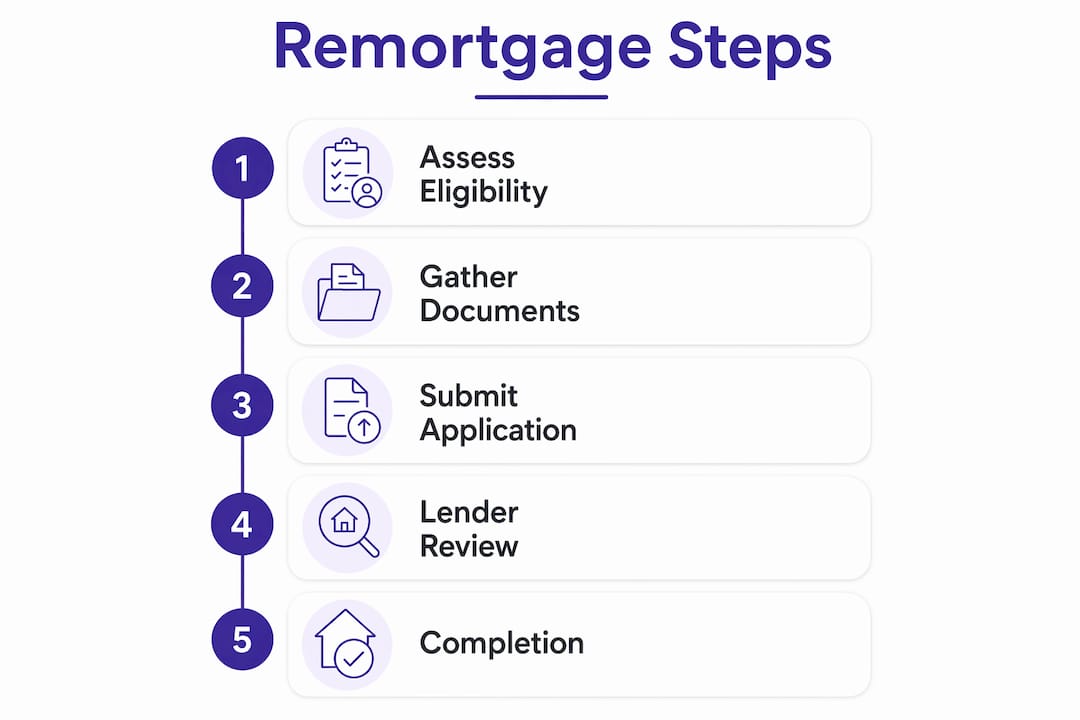
The process follows a clear sequence. Knowing each stage in advance reduces delays and prevents avoidable surprises.
-
Prepare your documents. Gather your passport, visa, proof of UK residency (utility bills, council tax statements), three to six months of UK bank statements, payslips or self-assessment records, and evidence of your deposit. If any income comes from overseas, prepare translated and certified copies.
-
Check your credit report. Pull your credit report from Experian, Equifax, or TransUnion before you apply. Errors on your file can delay or derail an application. Address any issues at least three months before submitting.
-
Speak to a specialist broker. A broker with experience in foreign national cases will identify which lenders are likely to accept your profile before you apply. This protects your credit score from unnecessary hard searches and saves significant time.
-
Submit your application. Your broker submits the application to the chosen lender. The lender’s underwriting team will assess your residency, visa status, income, and credit history. Expect additional questions if your income includes foreign currency earnings.
-
Property valuation. The lender instructs a surveyor to value the property. For a remortgage, this is usually a desktop valuation or a brief physical inspection rather than a full structural survey. The valuation confirms the lender’s security against the loan.
-
Legal conveyancing. A solicitor handles the legal transfer of the mortgage from your existing lender to the new one. For a straightforward remortgage, this is less complex than a purchase, but it still takes time. Budget two to four weeks for this stage.
-
Offer and completion. Once the lender issues a formal mortgage offer and the legal work is complete, your new mortgage completes. Your existing mortgage is repaid, and the new terms take effect.
Remortgaging as a foreign national is often easier than securing your first UK mortgage, provided you have established UK credit history and clear residency evidence. Lenders view an existing UK mortgage as proof of financial reliability, which works in your favour.
What pitfalls should foreign nationals watch for when remortgaging?
The most common problems are predictable and avoidable with the right preparation.
- Thin UK credit history. Lenders want to see a track record of managing UK credit. No credit cards, no UK loans, and no utility accounts in your name all raise red flags. Start building your credit profile well before you need to remortgage.
- Unverifiable deposit funds. Gifted deposits from overseas relatives or funds held in foreign accounts are difficult for lenders to verify. Funds must be traceable, and for higher LTV applications, they must sit in a UK account.
- Currency income discounts. If a significant portion of your income comes from overseas, the lender’s affordability calculation will be lower than your gross earnings suggest. Factor this in when deciding how much to borrow.
- Visa expiry timing. Applying when your visa has less than 12 months remaining will limit your lender options severely. Time your application to coincide with a fresh visa renewal where possible.
- Choosing the wrong lender. Applying to a lender with no foreign national policy wastes time and leaves a hard search on your credit file. Always confirm a lender’s foreign national criteria before applying.
Pro Tip: Ask your broker to request a decision in principle before a full application. This gives you a reliable indication of lender appetite without triggering a full hard credit search.
Key takeaways
The foreign national remortgage process in the UK is achievable in 2026, provided you meet residency, visa, income, and deposit criteria set by mainstream and specialist lenders.
| Point | Details |
|---|---|
| Residency and visa requirements | Most lenders require 12 months UK residency and at least 12–24 months remaining on your visa. |
| LTV improvements in 2026 | Hodge Bank lends up to 95% LTV and Santander up to 90% LTV for eligible foreign nationals. |
| Income currency discounts | Foreign currency income is discounted by up to 15% for major currencies, reducing your borrowing capacity. |
| Remortgaging is easier second time | Established UK credit history and an existing mortgage record significantly improve lender confidence. |
| Specialist broker support | A broker experienced in foreign national cases identifies suitable lenders before you apply, protecting your credit score. |
My view on the UK foreign national remortgage market
The shift I have seen in 2026 is genuinely encouraging. When I first started advising foreign nationals on UK mortgages, the options were narrow and the criteria were punishing. A 25–40% deposit was the norm, and even then, many lenders simply said no. The fact that Hodge Bank now lends at 95% LTV with a one-year residency requirement, and that Santander has published a clear foreign national policy with defined income thresholds, tells me the market is maturing.
What I tell every foreign national client is this: the process rewards preparation. The applicants who struggle are almost always those who underestimated the importance of UK credit history or who tried to use overseas savings as deposit evidence without understanding the documentation requirements. The applicants who succeed are those who spent six to twelve months building their UK financial footprint before they ever spoke to a lender.
My honest advice is not to apply alone. The foreign national mortgage market is fragmented. Lender criteria change frequently, and a broker who works in this space regularly will know which lenders are actively welcoming applications and which are quietly tightening their criteria. That knowledge alone can save you months of wasted effort.
— Paul
How Prosperhomeloans supports foreign nationals with UK remortgages
Remortgaging as a foreign national involves more moving parts than a standard application. Prosperhomeloans specialises in exactly this kind of case, working with foreign nationals across a range of visa types and residency situations to find the right lender and the right product.

We handle the documentation review, lender matching, and application process on your behalf, so you spend less time chasing paperwork and more time focused on what matters. Whether you are on a Skilled Worker visa, hold Indefinite Leave to Remain, or sit somewhere in between, we will give you a clear picture of your options before you commit to anything. Visit Prosperhomeloans to speak with an adviser who understands the foreign national remortgage process in the UK.
FAQ
What is a foreign national mortgage in the UK?
A foreign national mortgage is a UK home loan product available to non-British residents who meet specific residency, visa, and income criteria set by individual lenders. Eligibility varies by lender, but most require at least 12 months of UK residency and a valid visa.
How long do I need to have lived in the UK to remortgage?
Most mainstream lenders require a minimum of 12 months UK residency. Hodge Bank reduced its requirement to one year in june 2026, and some specialist lenders will consider shorter periods depending on your visa type and financial profile.
Can I remortgage in the UK if my income is paid in a foreign currency?
Yes, but lenders apply a discount to foreign currency income before calculating affordability. Major currencies typically face a discount of up to 15%, with higher discounts for emerging market currencies, so your effective borrowing capacity will be lower than your gross income suggests.
Do I need a UK bank account to remortgage as a foreign national?
A UK current account is a standard requirement across most lenders. For applications above 75% LTV, lenders also require deposit funds to be held in a UK account and evidenced through UK bank statements.
Is remortgaging easier than getting a first mortgage as a foreign national?
Remortgaging is generally easier if you have an existing UK mortgage and established credit history. Lenders treat a clean UK mortgage record as strong evidence of financial reliability, which improves your chances of approval and may give you access to better rates.
