First-Time Buyer Mortgage Process: Steps From Deposit to Keys

The first-time buyer mortgage process runs in a set order: work out what you can afford, save a deposit, get an agreement in principle, make an offer, apply for the mortgage, then let the valuation, conveyancing and exchange run through to completion. If you are self-employed, a CIS subcontractor or a company director, the same steps apply, but the income evidence you gather at the start matters more. We are a local mortgage and protection advice firm in Hastings, and we help first-time buyers across East Sussex through each stage.
TL;DR
- You usually need a deposit of at least 5% of the price, and the cheapest rates are typically offered at larger deposits.
- Get an agreement in principle before you view homes. It is a soft credit check and lasts around 90 days with some lenders.
- Lenders typically take 2 to 6 weeks to decide on a full application, and the whole journey from offer accepted to moving in is often about 12 weeks or longer.
- Budget for costs beyond the deposit: legal fees, valuation, surveys, arrangement fees and, above certain prices, stamp duty.
- Self-employed and CIS applicants should prepare their tax records early, because lenders assess income differently by lender.
Table of Contents
- Step 1: Work out what you can afford
- Step 2: Build your deposit
- Step 3: Get an agreement in principle
- Step 4: Find a home and make an offer
- Step 5: Apply for the mortgage
- Step 6: Valuation and survey
- Step 7: Mortgage offer, conveyancing and exchange
- How long does it all take?
- What else will it cost?
- Our view as a local broker
- Talk to a local mortgage adviser
- FAQ
- Sources
Step 1: Work out what you can afford
Start with your income and your spending. HSBC suggests comparing three months of income against spending to size both your savings rate and the repayments you can sustain. Remember the running costs too: council tax, utilities, repairs, broadband and home insurance.
On borrowing, MoneyHelper says the most you can borrow is usually capped at four-and-a-half times your annual income, but that is not guaranteed. Each lender applies its own affordability rules, so a calculator gives a rough guide only. Our post on common mortgage affordability calculator myths explains where those estimates can mislead.
Step 2: Build your deposit
MoneyHelper says you will need to save at least 5% of the purchase price. The deposit sets your loan-to-value (LTV), which is the mortgage compared with the property value. A £25,000 deposit on a £250,000 home gives 90% LTV. The same guide says the cheapest interest rates are typically available at 60% LTV, meaning a 40% deposit, because the lender takes less risk.

A bigger deposit can widen your choice, but a smaller one can still be workable. Which deals you can access depends on your circumstances and lender criteria.
If you are self-employed, lenders may ask where the deposit came from. Our guide to proving your deposit as a self-employed applicant covers what to keep ready, and deposits by job type shows how expectations can change with your work.
Step 3: Get an agreement in principle
GOV.UK advises getting a mortgage decision in principle before viewing properties. It is a written statement from a lender of what it might lend, and it does not commit you to that lender.
Nationwide says its decision in principle lasts 90 days and uses a soft credit check that does not affect your credit rating. Estate agents take you more seriously when you have one. It is not a guarantee of a mortgage. If you are unsure whether to use a calculator or go straight to an agreement in principle, see which comes first.
Step 4: Find a home and make an offer
Once your offer is accepted, the sale is still not legally binding. Either side can withdraw until contracts are exchanged. Tell your adviser and solicitor straight away so the full application can start.
Step 5: Apply for the mortgage
You can only make a full application once an offer has been accepted. The lender checks your income, spending and credit history. For employed buyers that usually means payslips and a P60. For others, it means more.
If you are a CIS subcontractor or self-employed
Expect to provide self-assessment tax calculations and tax year overviews, usually for the last two to three years, plus bank statements. CIS subcontractors may also have CIS vouchers or statements. Some lenders may use gross CIS earnings when assessing affordability, subject to their own criteria. That does not increase your actual income or guarantee higher borrowing, and not every lender takes this approach. Company directors may be assessed on salary and dividends, and some lenders will also consider retained profits.
This is where choosing the right lender matters. We arrange CIS subcontractor mortgages and self-employed and company director mortgages, and we look at the whole market, so your application goes to a lender whose criteria fit how you are paid.
If you are an NHS or healthcare worker from overseas, the UK visa holder mortgage checklist lists the documents and timescales to plan for.
Step 6: Valuation and survey
The lender will arrange a valuation to check the property is worth what you are paying. MoneyHelper notes this may be paid for by the lender, but you should check. Nationwide states its valuation does not assess the property’s condition, so a Level 2 or Level 3 survey is worth considering, at extra cost.
Step 7: Mortgage offer, conveyancing and exchange
MoneyHelper says it typically takes 2 to 6 weeks to find out whether a mortgage is approved. Your solicitor or conveyancer handles searches and the legal work. Offers do expire: Nationwide’s offer lasts 180 days, with a possible extension, and other lenders differ.
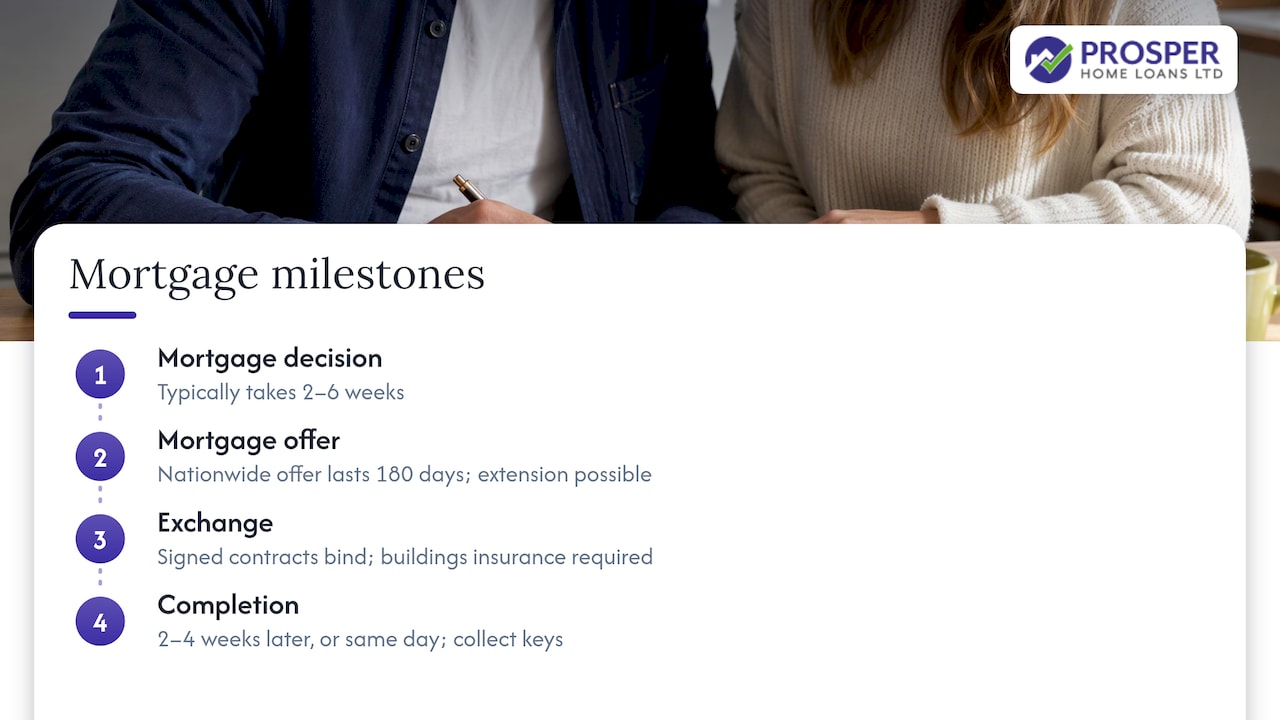
At exchange, the buyer and seller swap signed contracts that legally bind them, and you become responsible for the property, so buildings insurance must be in place. The same source says completion is often 2 to 4 weeks later, though it can be the same day. On completion day the money moves and you collect the keys.
How long does it all take?
| Stage | Typical timing |
|---|---|
| Agreement in principle | Minutes to a day |
| Mortgage application to decision | 2 to 6 weeks |
| Conveyancing | 6 to 12 weeks (NatWest) |
| Offer accepted to moving in | About 12 weeks (GOV.UK) |
Delays usually come from missing documents, slow chains and valuation queries. Having your paperwork ready is the easiest way to keep things moving.
What else will it cost?
GOV.UK lists extra costs including surveys, conveyancing, searches, building insurance, moving costs, mortgage costs and life insurance. As a rough guide, MoneySaving Expert budgets around £1,000 for an arrangement fee, £300 to £500 for a valuation and £800 to £2,000 in legal fees (2026 guide).
On stamp duty, in England and Northern Ireland first-time buyers pay none on homes up to £300,000 and 5% on the portion from £300,001 to £500,000. The relief is lost above £500,000. Check the current rules with HMRC before you budget.
Our view as a local broker
We meet many first-time buyers in Hastings, Bexhill, Eastbourne and Hailsham who feel the process is built for people on a payslip. If you are paid through CIS, as a contractor or through your own company, your income can be assessed in several ways, and which way is used depends on the lender.
Our approach is to explain the options, costs and risks clearly, and to support you from first enquiry through to completion and later reviews. We do not promise approval or particular rates, because these depend on your circumstances and lender criteria.
Getting income evidence in order before you make an offer is the most useful thing you can do.
Paul McMath CeMAP CeRER
Talk to a local mortgage adviser
We are a mortgage and protection advice firm based in St. Leonards-on-Sea, available to first-time buyers across East Sussex and the UK. Our first-time buyer mortgage service covers the steps above, and we can also help you consider life insurance, critical illness cover and income protection alongside your mortgage.

If you want to know what lenders may make of your income before you start viewing, get in touch with Prosper Home Loans.
FAQ
Can I buy a house with a 5% deposit?
Often, yes. NatWest says you need at least 5% of the sale price to potentially be eligible, based on the lower of price or valuation. Eligibility still depends on your income, credit history and the lender’s criteria.
Does an agreement in principle affect my credit score?
Not usually. Nationwide says its decision in principle uses a soft credit check that does not affect your credit rating. Lenders differ, so confirm the type of check before you apply.
What changes if I buy a first home to let out?
Buy-to-let lending is assessed mainly on the rent. One lender’s criteria set a 12-month owner-occupier residency requirement, a 75% maximum LTV and a minimum income of £25,000 for first-time landlords. Rules vary by lender, so speak to an adviser before applying.
How much should I keep as savings after buying?
HSBC recommends an emergency fund of at least three months of living expenses. Keep this separate from your deposit.
Sources
- MoneyHelper: How much can I borrow?
- MoneyHelper: First-time home buyer guide
- MoneyHelper: Mortgage loan application process
- GOV.UK: How to buy a home
- HSBC: Mortgage affordability
- Nationwide: How to buy your first home
- Nationwide: First-time buyer mortgages
- NatWest: First time buyer guide
- NatWest: Apply for a mortgage online
- MoneySaving Expert: First time buyers’ mortgage guide 2026
- Aldermore: Buy to let criteria guide
Recommended
- Proving Your Deposit as Self-Employed Mortgage Applicants
- Mortgage Application Steps After You Press Submit
- Mortgage Deposits by Job Type: What to Expect
This article provides general information and is not a personal mortgage recommendation. Mortgage availability and eligibility depend on your circumstances and lender criteria. Rates and criteria can change. We will explain any applicable fees before you commit. Think carefully before securing other debts against your home. Consolidating debts over a longer term may reduce your monthly payments but increase the total amount you repay. Your home may be repossessed if you do not keep up repayments
