Equity Release vs Downsizing: Which Suits You?

Equity release lets you stay in your home and borrow against it or sell part of it. Downsizing means selling and moving somewhere cheaper, so you keep the difference. Neither is better in every case. The right choice depends on how much you need, how attached you are to your home, what you want to leave behind and how long the money has to last. As a local mortgage and protection advice firm in Hastings, East Sussex, we help homeowners weigh both before they commit.
TL;DR
- Equity release is open to homeowners aged 55 and over. You stay in your home, but a lifetime mortgage adds interest and usually reduces what you leave behind.
- Downsizing releases cash by selling and buying cheaper, but moving costs, taxes and a new home’s running costs eat into what is left.
- Rolled-up interest compounds: Age UK says a £20,000 loan can double in 11 years at 6.5% a year.
- Compare the real figures for both routes side by side before deciding. Your circumstances and lender criteria decide what is available.
Table of Contents
- What each option actually involves
- Comparing the two side by side
- The numbers that decide it
- Eligibility and benefits: check before you choose
- When each tends to fit
- How we approach the choice
- Talking it through with an adviser
- FAQ
- Sources
What each option actually involves
Equity release is a way for homeowners aged 55 and over to use the value tied up in their home. There are two main types, according to Age UK’s equity release factsheet:
- Lifetime mortgage: a loan secured against your home, usually repaid when the last borrower dies or moves into permanent long-term care. Interest is either paid regularly or “rolled up” into the loan.
- Home reversion plan: not a loan, so there is no interest. You sell all or part of your home for cash, and the provider takes its share of the sale proceeds later.
In both cases, MoneyHelper explains that you live in the home for life, rent-free. If you want the detail on the two types, we have set out home reversion versus lifetime mortgage in a separate guide.
Downsizing is simpler to describe. MoneyHelper says you sell your home, use the proceeds to buy or rent somewhere cheaper and keep the cash left over.
Comparing the two side by side
| Factor | Equity release | Downsizing |
|---|---|---|
| Minimum age | Usually 55 | None |
| Do you move? | No | Yes |
| Debt | Lifetime mortgage creates a loan that can grow with rolled-up interest | No new borrowing needed if you buy outright |
| Ownership | Kept with a lifetime mortgage; sold in whole or part with home reversion | You own the new, cheaper home |
| Inheritance | Usually reduced | Usually reduced less, depending on what you keep |
| Upfront costs | Set-up fees | Moving, legal and tax costs |
| Reversibility | Early repayment may be needed if you move | A move normally cannot be undone |
The inheritance point matters to most families. The Equity Release Council warns that a plan could leave your family with little or nothing to inherit, because the provider’s first charge often means the property has to be sold.
The numbers that decide it
Downsizing: what you keep after the move
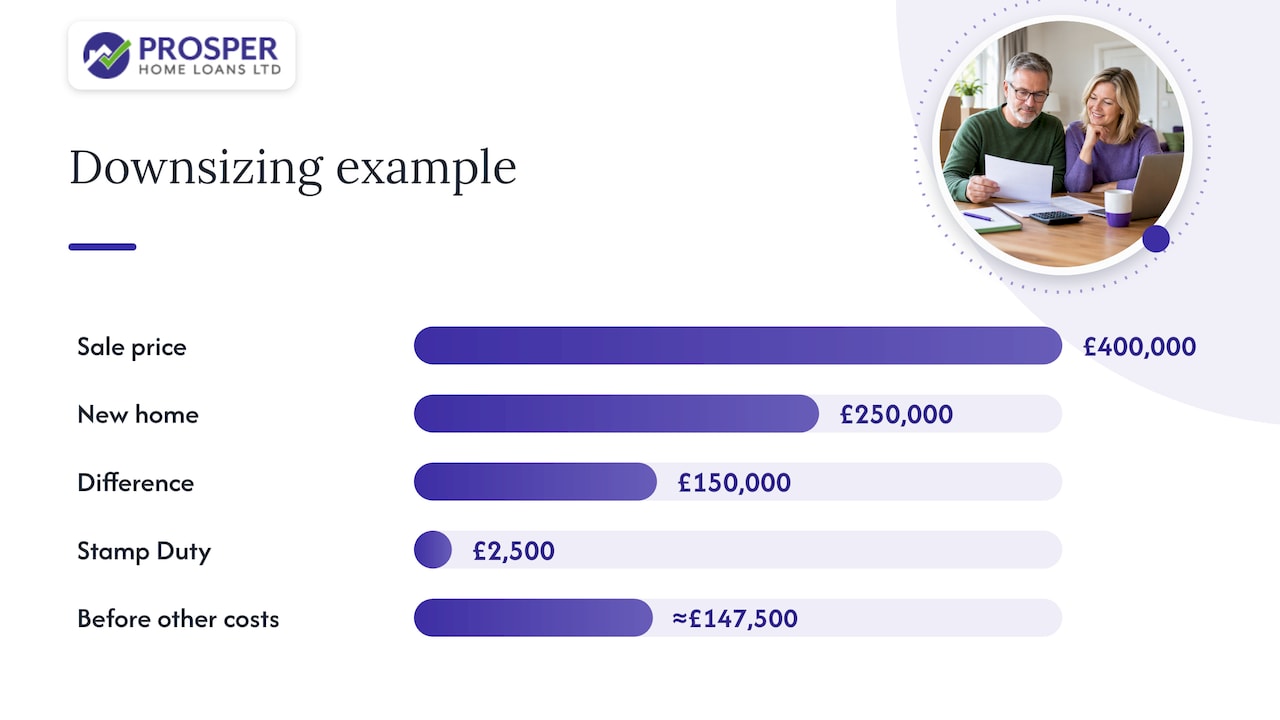
MoneyHelper says what you keep depends on your sale price, the price of the new home and the costs of buying or renting, moving (including legal fees and taxes) and any renovation or adaptation. It also advises checking bills at the new address, such as energy, insurance, broadband and Council Tax.
Here is a simple, hypothetical example for a purchase in England:
- Sale price of your current home: £400,000
- Price of the new home: £250,000
- Difference before costs: £150,000
- Stamp Duty Land Tax on £250,000 as your only home: nil on the first £125,000, then 2% on the next £125,000, so £2,500 (RSM Tax Facts 2026-2027)
That leaves about £147,500 before agent, legal and removal costs, and before any work on the new place. Scotland and Wales use different taxes and rates, and a second property carries a 5% surcharge, so check your own position.
Equity release: what it costs over time
Age UK notes that equity release involves set-up fees, and you remain responsible for repairs, insurance, Council Tax and other bills. The typical minimum borrowing is £10,000, and the maximum depends on your age and your home’s value.
The key figure is compounding. On a roll-up lifetime mortgage, a £20,000 loan can double in 11 years at 6.5% a year. That is why term, rate and whether you pay interest as you go all matter. Age UK also suggests looking for a “no negative equity” guarantee, which means you will not owe more than the sale proceeds, and most lifetime mortgages have fixed rates.

Inheritance Tax
Both routes can change what your estate is worth, and so how much Inheritance Tax applies. For 2026-27, RSM lists a nil rate band of £325,000, plus a £175,000 residence nil rate band when a main home passes to direct descendants, with unused amounts transferable between spouses and civil partners. MoneyHelper says downsizing might affect the calculation depending on who inherits, and that a regulated adviser can explain the rules.
Eligibility and benefits: check before you choose
For equity release, Age UK lists the usual criteria: a minimum age of 55, an age-dependent maximum amount, owning your home, a minimum property value and repaying any secured debt from the funds. Some properties may be restricted.
Financial Conduct Authority rules require advice on equity release to consider means-tested benefits, tax, alternatives, eligibility and your future plans, including the impact on local-authority-funded care. Extra money in your hands, from either route, can affect means-tested benefits, so raise this at the start.
If you are still paying a mortgage, the secured debt has to be cleared from the release. Our guide to equity release with a mortgage shows what to check.
When each tends to fit
Equity release may suit you if:
- you want to stay in a home you love, in a community you know
- your home is already well adapted to your needs
- you need a specific sum, for example for home improvements or care costs
- leaving the full value of the property is not your priority
Downsizing may suit you if:
- your home is bigger or more expensive to run than you need
- you want to avoid new borrowing
- you are ready to move and the new area suits your future needs
MoneyHelper says the decision depends on how well your current home meets your needs now and later, and whether you are comfortable with an emotional move. Thinking about leaving a long-term home is as much about family and routine as numbers, so give it time.
Some homeowners in their 50s and 60s do not need equity release at all. If you are still working, for example as a self-employed contractor, a remortgage or a change of mortgage term may be worth comparing. We cover this in remortgaging to release equity.
How we approach the choice
We start with what you want your next ten or twenty years to look like, then test each route against it. Some people come to us expecting equity release and find that a smaller home gives them what they need. Others find that staying put, with a carefully chosen lifetime mortgage, is the right fit.
We explain the costs and risks plainly, including how interest builds up and what a plan can mean for your family’s inheritance. Nothing here depends on one answer being the right one. It depends on your circumstances and on what lenders and providers will offer.
As a local firm in East Sussex, we can talk it through in person or by phone, and stay with you from the first conversation through to completion and later reviews.
Paul McMath CeMAP CeRER
Talking it through with an adviser
We are a mortgage and protection advice firm based in St. Leonards-on-Sea, helping homeowners in Hastings, Bexhill-on-Sea, Eastbourne, Hailsham and across East Sussex and the UK. Our services include lifetime mortgages and equity release, as well as remortgages and home mover mortgages, so we can look at the options together rather than in isolation.

If you are weighing up a lifetime mortgage against a move, see our lifetime mortgage and equity release page. No approval or saving is guaranteed, and what is available depends on your circumstances and lender criteria.
FAQ
What does equity release mean in the UK?
It is a way for homeowners aged 55 and over to access money tied up in their home. The two main types are lifetime mortgages and home reversion plans. You usually stay in the home for life, and the amount owed or the provider’s share is paid from the sale after you die or move into long-term care.
Does downsizing always release money?
Not always. The cash left depends on the gap between sale and purchase prices, minus moving costs, legal fees and taxes such as Stamp Duty Land Tax. Run the figures for a specific property before you decide.
Will equity release affect my family’s inheritance?
It usually reduces it. Interest may be added to the loan, and the property often has to be sold to repay the provider. Talk to your family and your adviser about this before going ahead.
Can I do equity release and downsize later?
Yes, but moving later can require partial or full repayment of the plan, according to Age UK. Ask about portability and repayment terms before choosing a product.
Sources
- Equity release factsheet, Age UK, February 2026
- What is equity release?, MoneyHelper
- Downsizing for retirement, MoneyHelper
- FAQs, Equity Release Council
- Tax Facts 2026-2027, RSM
- Relocation home sale
Recommended
- Equity Release With a Mortgage: How It Works and What to Check
- UK 55+ homeowners: Equity release for home care with adviser checklist
- 80% LTV: How Remortgaging to Release Equity Works in the UK
- Home Reversion vs Lifetime Mortgage: Key Differences Explained
This article provides general information and is not a personal mortgage recommendation. Mortgage availability and eligibility depend on your circumstances and lender criteria. Rates and criteria can change. We will explain any applicable fees before you commit. Think carefully before securing other debts against your home. Consolidating debts over a longer term may reduce your monthly payments but increase the total amount you repay. Your home may be repossessed if you do not keep up repayments
