Dividend Income Mortgages in the UK: What Lenders Count

Yes, you can get a mortgage when much of your income comes from dividends, but how much a lender will count depends on its own criteria. Most lenders look at the salary and dividends you have actually been paid, backed by your tax records. They don’t look at the company’s total profit. Below we explain how that works, what paperwork to have ready and where things commonly go wrong.
TL;DR
- Lenders generally assess limited company directors in a similar way to self-employed applicants, so expect to be asked for two to three years of SA302s and tax year overviews.
- Salary and dividends paid to you are what usually count. Profit left in the company is often excluded, though some lenders treat it differently.
- Lenders may average your dividends over two years or use the lower figure, so a steady history helps.
- Dividend vouchers and board minutes matter: lenders want proof the dividends were properly declared.
- A decline from one lender does not mean you can’t borrow. Criteria vary, and a broker can search the market for a better fit.
Table of Contents
- How lenders look at dividends
- Salary, dividends and retained profit
- The proof lenders ask for
- Common reasons a dividend-based application stalls
- If you also work under CIS
- Debt and dividends: consolidation is not a quick fix
- Our view on dividend income and mortgages
- Speak to a local broker
- FAQ
- Sources
How lenders look at dividends
A lender has to be satisfied that you can afford the repayments, not just that your business is doing well. The FCA’s mortgage rules require firms to assess affordability before lending, and the regulator has said that assessment should not rest solely on income multiples. For self-employed applicants, lenders are expected to check that the income is real and plausible.
For a director, that usually means the money that has reached your personal bank account. MoneyHelper explains that lenders review income, outgoings and the security of your employment. They then subtract essential costs and existing debt commitments before deciding what you can borrow. It also notes that lenders typically cap borrowing at around 4.5 times annual income, and that most people are offered less.
So two directors with the same company profit can be offered very different amounts. It depends on how much each has paid themselves, how consistently, and which lender looks at the case.

Salary, dividends and retained profit
Many directors take a modest salary and top up with dividends. That can make sense for tax reasons, and your accountant will advise on it. For a mortgage, it means your assessable income is split into two parts:
- Salary: straightforward, and usually shown on payslips and your tax calculation.
- Dividends: taken from company profits after Corporation Tax. Many lenders want to see a track record.
- Retained profit: money left in the company. Many lenders ignore it. A smaller number of lenders will consider it, subject to their criteria.
This is the point that surprises many directors. A strong company with a low personal income can look weaker on paper than you would expect. If you are planning to buy within the next year or two, it is worth talking to your accountant and a broker before you change how you pay yourself. We can’t give tax advice, but we can show you how lenders are likely to read the numbers.
A worked example
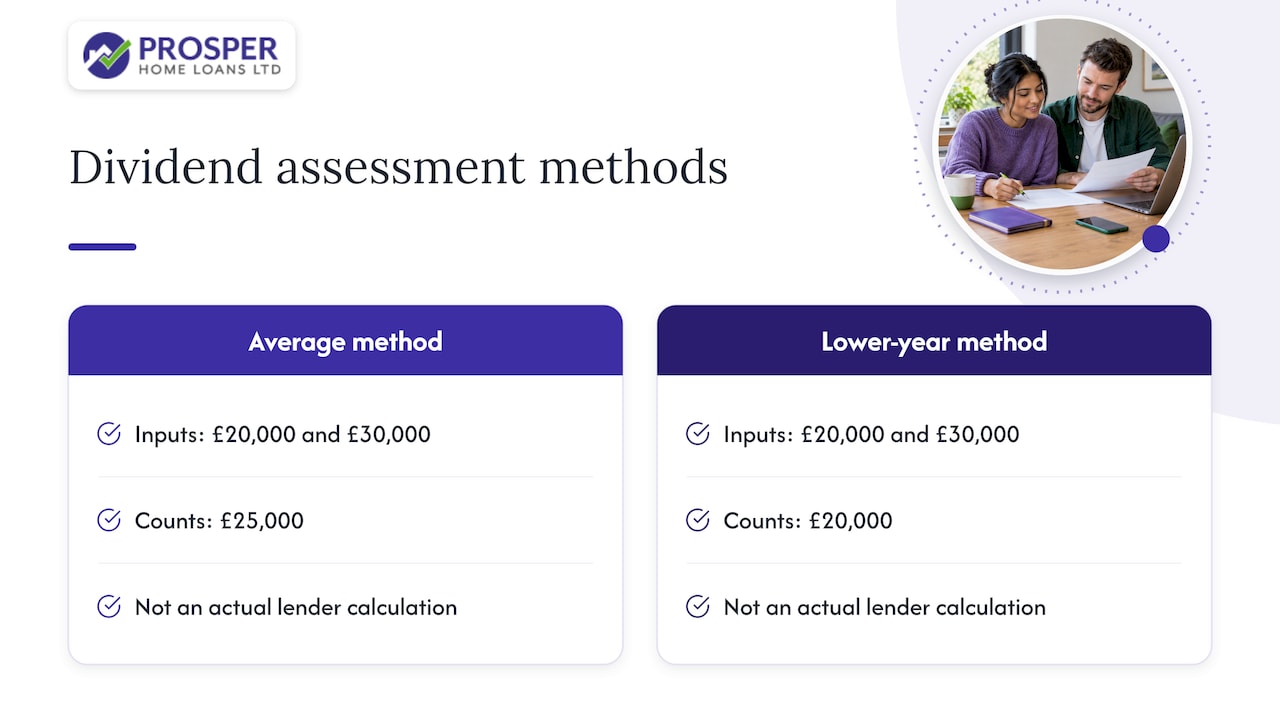
Take a director who pays herself a salary and then dividends of different sizes over two years. Suppose she pays herself £20,000 in dividends in the first year and £30,000 in the second. Some lenders would take an average of the two years. Others would use the lower figure. The result could be that the lender counts £25,000 or £20,000 rather than the £30,000 she took most recently. These figures are purely illustrative, not a lender’s actual calculation. They show why a rise in dividends just before applying doesn’t always translate into higher borrowing. MoneyHelper’s application guidance describes lenders using an average or the lower of recent years.
The proof lenders ask for
Expect to provide:
- SA302 tax calculations and tax year overviews, normally for the last two to three years. Dividends not taxed through PAYE must be declared on a Self Assessment tax return.
- Company accounts, and sometimes an accountant’s reference.
- Dividend vouchers showing the date, company name, shareholder name and amount.
- Minutes of the board meeting that declared each dividend.
- Personal bank statements showing the money arriving.
GOV.UK says dividends must be paid from available profits after Corporation Tax, and that directors should keep records of vouchers and meeting minutes. If these are missing, a lender may question whether your income is what you say it is, and your application can stall. Tidying your records before you apply saves weeks.
If you want an outside view of how to organise your paperwork and prepare for lender questions, a personal loan and credit readiness consultancy offers document organisation and readiness reviews. That is separate from mortgage advice, which is regulated.

Common reasons a dividend-based application stalls
- Income that is too new. A first year of trading, or a sharp change in how you pay yourself, leaves little history to average.
- Dividends that vary widely. Large swings between years make lenders cautious.
- Unsecured debts. Lenders must show the loan is affordable after your committed costs, so credit cards, loans and car finance reduce what they will offer.
- Weak paperwork. Missing vouchers, minutes or tax calculations.
- Applying to the wrong lender. MoneyHelper notes that common decline reasons include credit history, too much debt, employment history and not earning enough, and that a decline can happen even after an agreement in principle.
A decline from one lender is not a verdict on you. Lenders treat variable income such as dividends, bonuses or CIS earnings differently, so the same case can look quite different elsewhere.
If you also work under CIS
Some directors and self-employed construction workers have mixed income: a limited company alongside CIS-taxed work, or a move from one to the other. How you are structured changes what lenders look at. Some lenders may use gross CIS earnings when assessing affordability, subject to their criteria. That does not increase your actual income, and it does not guarantee you can borrow more. Our guide to self-employed versus subcontractor mortgages and our explainer on subcontractor limited company mortgage differences cover this in more detail.
Debt and dividends: consolidation is not a quick fix
If your income is dividend-based and you are carrying unsecured debts, you may be wondering about a debt consolidation remortgage or a secured loan. These can lower your monthly outgoings, but they are not right for everyone:
- Lower monthly payments often mean a longer term, and so a higher total cost over time.
- Debts that were unsecured become secured against your home. If you can’t keep up the payments, your home could be at risk.
- Alternatives may suit you better, such as a repayment plan with your creditors, free debt advice, or clearing the debts from savings.
A lender will also test whether the new borrowing is affordable using the same dividend evidence described above. We look at your whole position and explain the costs and risks before you decide.
Our view on dividend income and mortgages
We see directors who are doing well but whose paperwork doesn’t tell that story. Usually the fix is not clever: it is understanding how lenders read your income before you apply, rather than after a decline.
We would rather talk early. A conversation a year before you plan to buy can show you whether your salary and dividend mix will support the borrowing you want. It can also show which lenders are likely to look at your case sensibly. We can’t promise approval or a particular amount, because it always depends on your circumstances and each lender’s criteria. What we can do is explain your options plainly, including the costs and risks.
— Paul McMath CeMAP CeRER
Speak to a local broker
Prosper Home Loans is based in St. Leonards-on-Sea and helps directors, self-employed people and contractors across Hastings, Eastbourne, Hailsham, Bexhill-on-Sea and wider East Sussex, as well as clients across the UK. Our self-employed and company director mortgage service looks across the whole market for lenders whose criteria fit your income. If you are considering consolidating debts, we can also talk through second charge mortgages and secured loans alongside the alternatives. MoneyHelper recommends taking advice if your income is more complex than a standard salary.
FAQ
Do dividends count towards mortgage income?
Often they do, but it depends on the lender. Most want to see dividends declared on your Self Assessment and supported by SA302s, usually for two to three years. Some use an average and others the lower year.
Can I use my company’s retained profits?
Many lenders only count what you have been paid, so retained profit is often excluded. A smaller number of lenders will consider it, subject to their criteria. A broker can tell you which ones are worth approaching for your situation.
How many years of accounts do I need?
Two to three years of SA302s and tax year overviews is typical for directors. Some lenders may consider less in certain cases, but your options are usually narrower. Ask a broker before applying, since each application leaves a footprint on your credit file.
Is a mortgage adviser worth using as a director?
For dividend-based income, usually yes. An adviser can search the whole market for lenders whose criteria suit you and help you assemble the documents. Advisers must tell you what they charge and how they are paid when you first speak, so ask.
Sources
- FCA Handbook, MCOB 11.6 responsible lending
- MoneyHelper: What mortgage can I afford?
- MoneyHelper: How to apply for a mortgage
- MoneyHelper: What to do when your mortgage application is declined
- MoneyHelper: Should you use a mortgage adviser?
- GOV.UK: Taking money out of a limited company
Recommended
- Buy to Let Minimum Income in the UK: Why £25,000 Often Matters
- 2026–26 UK Data: Interest-Only Residential Mortgages and Adviser Checklist
- East Sussex Contractors: What to Package for a Day Rate Mortgage
- When Offset Mortgages Pay: Tax and Cash Rules for UK Landlords
This article provides general information and is not a personal mortgage recommendation. Mortgage availability and eligibility depend on your circumstances and lender criteria. Rates and criteria can change. We will explain any applicable fees before you commit. Think carefully before securing other debts against your home. Consolidating debts over a longer term may reduce your monthly payments but increase the total amount you repay. Your home may be repossessed if you do not keep up repayments
