Development Finance Explained for UK First-Time Developers
Development finance is a short-term loan that pays for buying a site and building or converting on it, released in stages as the work progresses and repaid when the finished units are sold or refinanced. It is not a mortgage on a home you live in. If you work in the trades and are thinking about your first scheme, this guide covers how the money moves, what lenders look at and where first-timers get caught out.
TL;DR
- Development finance is short-term funding, usually 6 to 24 months, for buying land or a building and paying for the works.
- Lenders look at the finished value of the project and the cost of getting there, not your salary or CIS income alone.
- Money is normally released in stages as work is completed, and lenders rarely fund 100% of the cost.
- Mezzanine finance is a second layer of borrowing that reduces the cash you put in, at a higher price.
- Your plan for repaying the loan, by sale or refinance, matters as much as your build plan.
Table of Contents
- What development finance is
- How development finance works, step by step
- How much can you borrow?
- Mezzanine finance and the capital stack
- What lenders assess, and what that means for a first-time developer
- Costs to budget for
- Planning the exit
- Our view
- Talk to a local broker
- FAQ
- Sources
What development finance is
A standard residential mortgage is based on your income and the current value of a property. Development finance works the other way round. The lender assesses the project: what the site costs, what the build will cost and what the finished property should be worth. That finished value is called the gross development value, or GDV.
It can fund ground-up schemes, such as buying a plot and building houses or flats, and heavier conversions, such as turning offices into homes. Lenders describe it as secured, short-term lending for residential, mixed-use and commercial projects, covering mortgages, term loans, bridging and mezzanine finance under the wider heading of property development finance.
For a lighter project, such as buying a house, refurbishing it and selling it, a bridging loan is often the tool instead. We cover the difference in our guide to heavy refurbishment bridging.
How development finance works, step by step
Lenders structure these loans in slightly different ways, but the sequence is broadly the same.
- Site purchase. A first part of the facility is used to buy the land or building. One lender describes the loan as two parts: the purchase, then the build costs, with terms of 6 to 24 months.
- Build funding in stages. The build element is usually drawn down in tranches as works are completed, often monthly. A surveyor appointed for the lender normally checks progress before each release, so you will need to fund early costs and keep to your programme.
- Interest. Many lenders let interest roll up, meaning it is added to the loan and paid at the end rather than monthly. You only pay interest on money actually released. Check how each lender charges it, as terms differ.
- Repayment. The loan is repaid when units sell or when you refinance onto longer-term finance. On schemes with several units, some lenders allow partial repayment as each one sells.
The Development Bank of Wales also notes that development loans are released in stages based on project milestones. That is why a realistic build programme matters. A delay does not just cost time, it can hold up the next release of funds.
If you plan to build a home for yourself, the process is different: see how self build mortgage stages release money.

How much can you borrow?
Don’t expect 100% funding. The Construction Leadership Council’s guide for small housebuilders says lenders will, with few exceptions, not lend the entire development cost. They lend a percentage of cost or of GDV, and expect a fully funded project from day one.
Two ratios come up constantly:
- Loan to cost (LTC): the loan as a share of total project costs.
- Loan to GDV (LTGDV): the loan as a share of the expected finished value.
A worked example: a scheme with total costs of £800,000 and a lender offering 60% of cost would lend £480,000. You would need to find the remaining £320,000 as cash, land equity or other funding. The figures here are illustrative only and are not a lender offer.
The same guide explains that the developer’s own money normally goes in first and their return comes out last. Lenders also typically ask for personal guarantees, and the lower your own equity, the more likely a guarantee is to be required. A personal guarantee means you could be personally liable if the project does not repay the loan, so read it carefully and take legal advice before you sign.

Mezzanine finance and the capital stack
Most projects are funded from a capital stack: your equity, then optional mezzanine or junior debt, then senior debt from the main lender. The CLC guide notes that higher leverage generally costs more.
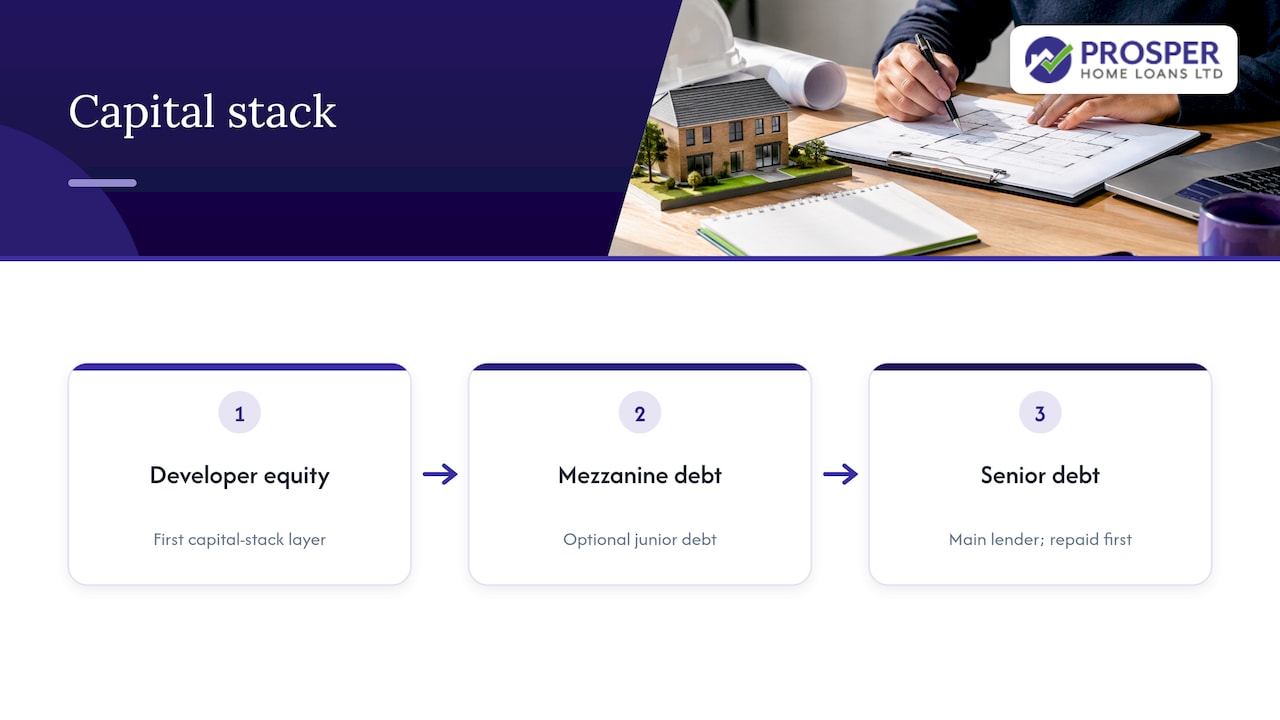
Mezzanine finance sits behind the senior loan. If the project struggles, the senior lender is repaid first, so mezzanine lenders charge more for the extra risk. It can reduce the cash you need to put in, but it adds cost and another party to the deal.
For a sense of scale, the Investment Property Forum’s research on year-end 2014 found mezzanine for fully pre-let commercial development carried margins of 800 to 1,200 basis points. A basis point is one hundredth of a percentage point, so that is 8% to 12% over the lender’s base rate. That is a commercial-sector snapshot from 2014, not a current quote. Pricing moves with the market and with the lender’s view of your scheme.
What lenders assess, and what that means for a first-time developer
Yes, first-time developers can borrow, but you need to show you can deliver. According to the CLC guide, where experience is lacking you need clear evidence of transferable skills plus strong planning and sales ability. For people from the trades, hands-on construction experience is a real asset, but lenders will also want to see that you can manage costs, contractors and a sale.
Expect lenders to look at:
- Planning permission. Lending generally proceeds only once permission is in place or very close to certain.
- Build costs. Realistic, supported by quotes or a quantity surveyor, with a contingency.
- Sales evidence. Comparable sales that support your quoted values.
- Your track record. Previous projects, or the team and skills you bring.
- Your exit. Sale, or refinance onto a longer-term loan once the building is finished.
If your income is mainly CIS or self-employed earnings, that is still relevant, particularly for personal guarantees and for any lending against your own home. Lender criteria differ, so it is worth having your tax returns and figures ready.
Costs to budget for
Beyond interest, budget for arrangement fees, exit fees, valuation and monitoring surveyor costs, and legal fees. The IPF’s 2011 outlook report recorded typical pricing at that time of upfront fees of 1% to 3% and margins of 2.75% to 4.5%. That was a 2011 view of bank lending, so treat it as context for the kinds of charge involved, not as today’s pricing.
The same report describes London lending as more concentrated, with some lenders focused solely on the capital. If you are looking at a scheme in London or the South East, the lenders who suit you may differ from those who suit a smaller regional site.
Planning the exit
A development loan is short-term, so the repayment plan is part of the application. If you intend to sell, your lender will want to see realistic values and timescales. If you intend to keep the properties as rentals, you will need longer-term finance when the build ends. Our guide to development exit finance covers the options at practical completion. If you are starting with a plot, bridging against land is another route some people use before the main facility is in place.
Our view
Most first-time developers we speak to are skilled builders who have never had to present a project to a lender. The build is rarely the weak point. The paperwork around it is: costs, sales evidence, the exit and how the funding fits together.
We would rather you understood the structure before you commit to a site. Know how much cash you need, what a personal guarantee means for you and your home, and how you will repay the loan if sales take longer than planned.
Every project and every borrower is different, and lender criteria vary, so we look at your circumstances first and explain the costs and risks plainly before you decide anything.
Paul McMath CeMAP CeRER
Talk to a local broker
We are a mortgage and protection advice firm based in St. Leonards-on-Sea, and we help clients in Hastings, Bexhill-on-Sea, Eastbourne, Hailsham and across East Sussex and the UK. Our services include bridging and commercial finance, and we work with self-employed people, CIS subcontractors and company directors.

If you are weighing up a first project, you can look at our bridging and commercial finance page, or speak to us about how your own income and borrowing would be viewed alongside the scheme. Nothing here is a promise of approval or of any rate.
FAQ
Can first-time developers get development finance?
Yes, though lenders will want evidence you can deliver. That usually means transferable skills, a realistic budget, planning permission and a clear exit. A track record helps, but a strong team can partly make up for a lack of one.
Can development finance cover 100% of a project?
Rarely. Lenders typically lend a percentage of cost or GDV and expect the developer to contribute first. Mezzanine finance can reduce your cash input, but it costs more and adds complexity.
What does rolled-up interest mean?
Interest is added to the loan balance during the term instead of being paid monthly, and is settled when you repay. Because it compounds on the balance, it increases the total you owe, so factor it into your budget.
How long does development finance last?
Terms are usually between 6 and 24 months, set to match your build programme and sale period. Some lenders describe it as a short-term facility of 6 to 24 months, so always allow some contingency for delays.
Sources
- How to finance property development, Development Bank of Wales
- How does development finance work?
- Becoming a small housing developer: advice and guidance, Construction Leadership Council (2022)
- IPF research, year-end 2014 mezzanine and junior debt
- Outlook for Development Finance in the UK, Investment Property Forum (2011)
Recommended
- Development exit finance: your options at practical completion
- Light Refurbishment Bridging for UK Investors: AVM or Survey?
- Self Build Mortgage Stages: How the Money Is Released
This article provides general information and is not a personal mortgage recommendation. Mortgage availability and eligibility depend on your circumstances and lender criteria. Rates and criteria can change. We will explain any applicable fees before you commit. Think carefully before securing other debts against your home. Consolidating debts over a longer term may reduce your monthly payments but increase the total amount you repay. Your home may be repossessed if you do not keep up repayments
