Critical Illness Cover Explained for Self-Employed Workers

Critical illness cover is an insurance policy that usually pays you a tax-free lump sum if you are diagnosed with a serious illness listed in your policy, such as cancer, a heart attack or a stroke. If you are self-employed, a CIS subcontractor or a contractor, there is no employer sick pay behind you, so that lump sum can be used to keep the mortgage paid while you get better. We arrange this kind of cover alongside mortgages from our office in St. Leonards-on-Sea, and we work with clients across Hastings, Eastbourne, Hailsham, Bexhill-on-Sea and the rest of East Sussex.
TL;DR
- Critical illness cover pays a lump sum on diagnosis of a condition named in the policy, according to MoneyHelper, and it usually does not pay out on death.
- Cancer, heart attack and stroke must be covered by every product that calls itself critical illness insurance under the ABI’s minimum standards. Beyond that, the list of conditions varies a lot by policy.
- The lump sum is often used to clear or reduce a mortgage, but you can spend it on anything: lost earnings, adaptations, or time off.
- Cost depends on your age, health, smoking status, occupation, the amount of cover and the term. The policy wording matters as much as the price.
- Your needs depend on your circumstances, so a conversation with an adviser before you choose is worth having.
Table of Contents
- What critical illness cover is, in plain terms
- What it usually covers
- How a claim works
- Critical illness cover when you are self-employed
- What affects the cost and the amount of cover
- Our view as mortgage advisers
- Talk to a local adviser
- FAQ
- Sources
What critical illness cover is, in plain terms
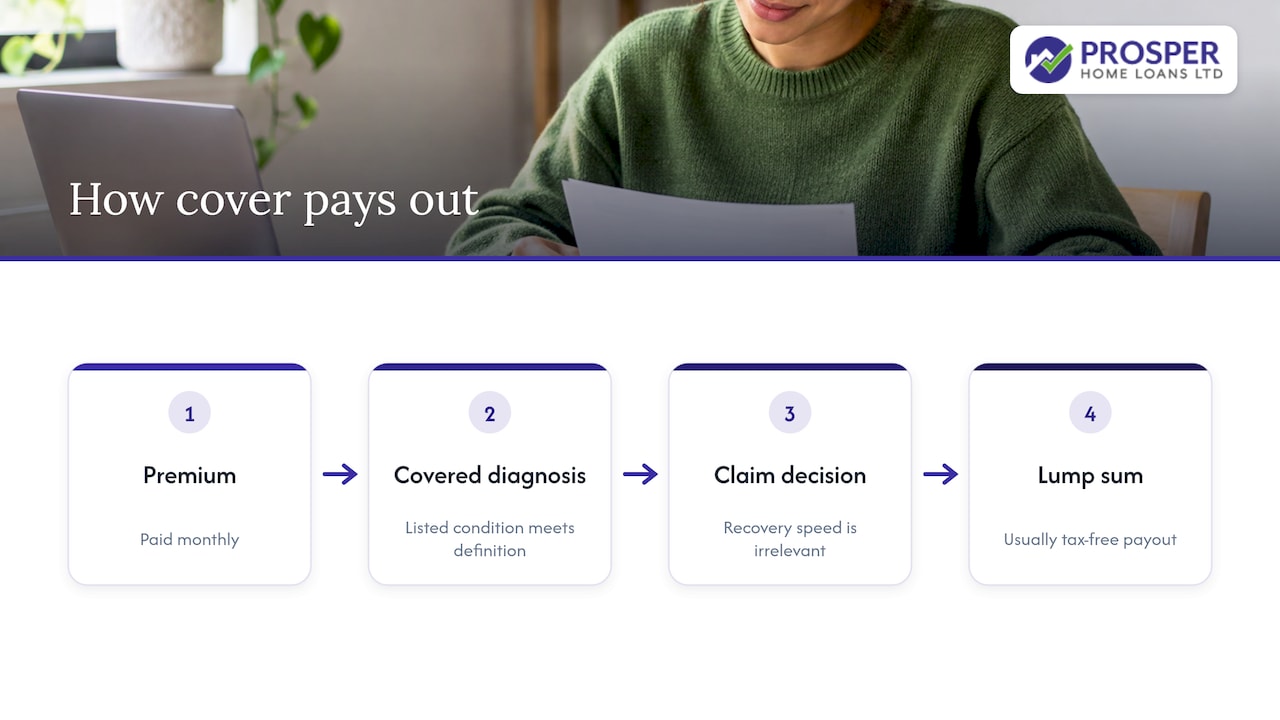
You pay a monthly premium. If you are diagnosed with a condition that appears in your policy and meets the policy’s definition, the insurer pays a cash lump sum. MoneyHelper, the government-backed money guidance service, describes it as a long-term policy that usually pays a tax-free lump sum for a covered serious illness.
The Financial Conduct Authority describes stand-alone critical illness cover as a policy that pays a lump sum if you are diagnosed with a prescribed non-fatal serious illness or medical condition. The word “prescribed” matters. The policy lists what counts, and each listed illness has its own definition.
The Chartered Insurance Institute adds a point that surprises many people: the payout depends on the diagnosis meeting the definition, not on how well or how quickly you recover. Once the definition is met, the claim stands.
What it usually covers
The Association of British Insurers (ABI) sets minimum standards for the industry. Under them, cancer, heart attack and stroke must be covered by every product sold as critical illness insurance. Many insurers add other conditions on top.
MoneyHelper says cover varies significantly between insurers, and that the most comprehensive policies can cover 50 different conditions or more, while others are much more limited. This is why two policies with a similar monthly cost can behave very differently at claim time.
Some policies also offer:
- Smaller payments for less severe conditions, so you receive part of the cover earlier in the course of an illness.
- A payment if one of your children has a specified condition, on policies that include it.
- Cover enhancements. The FCA notes these can extend the list of illnesses or allow more than one claim on the same policy.
A hysterectomy is a common question. It is not a blanket cover item. In the example policy the Chartered Insurance Institute describes, a hysterectomy for carcinoma in situ of the cervix appears as a partial-payment condition, paying the lower of 12.5% of the cover and £12,500. Your own policy may differ, so check the definitions.
How a claim works
The sequence is straightforward:
- You are diagnosed by a consultant or specialist with a condition listed in your policy.
- You tell your insurer and send the medical evidence it asks for.
- The insurer checks the diagnosis against the wording of that condition’s definition.
- If it is met, the lump sum is paid. Most policies expect you to survive for a set period after diagnosis, so read that term in your policy documents.
Where claims go wrong is usually the paperwork at the start. MoneyHelper advises checking the exclusions and how serious a condition has to be to qualify. Common exclusions include non-invasive cancers, high blood pressure and injuries such as broken bones. The FCA also points out that most protection is medically underwritten, so you will be asked for your medical history and current health. Answer those questions fully and accurately when you apply, because that is what the insurer relies on later.
Critical illness cover when you are self-employed
Employees often have some sick pay. A CIS subcontractor, sole trader or contractor usually does not. If you cannot work, the income stops while the mortgage, rent, van finance and household bills carry on.
MoneyHelper says critical illness insurance is designed to pay off debts, including a mortgage, or pay for home alterations. It also lists the other main types of personal cover:
- Life insurance usually pays your dependants a lump sum, or regular payments, if you die.
- Critical illness cover usually pays you a lump sum on diagnosis of a listed condition.
- Income protection pays part of your lost earnings while you are unable to work through sickness or injury.
They do different jobs and many self-employed people look at more than one. Our guide to income protection and critical illness cover shows how they fit together, and mortgage protection and life insurance covers the death-benefit side.
A lump sum is also separate from state disability benefits. If you are weighing up what support you could claim, there is help with PIP and DLA claims for people who need it with applications and appeals.
A worked example
Imagine a bricklayer in Bexhill-on-Sea with a mortgage balance of £150,000 who is paid under CIS. He chooses critical illness cover for £150,000. If he were diagnosed with a covered condition that met the policy definition, the lump sum could clear the mortgage, or he could keep it for other costs during treatment and recovery. This is an illustration only, not a quote, and the amounts, term and cost depend on the individual and the insurer.
What affects the cost and the amount of cover
MoneyHelper lists the factors that move the price: age, smoking status, current health, weight, family medical history, occupation, level of cover, and whether the payout is fixed or rises with inflation. Reviewable premiums are usually reviewed every five years, so find out whether yours is guaranteed or reviewable.
To decide how much cover to ask for, MoneyHelper points to your debts, dependants, any work benefits, take-home pay, mortgage or rent payments and other insurance you already hold. For many homeowners the mortgage balance is the starting point. If your mortgage reduces over time, our guide to decreasing and level term cover explains how the cover can be matched to the loan.
When you compare policies, look at:
- which cancers are covered, and at what stage
- whether smaller payments are made for less severe conditions
- how serious a condition must be before you can claim
- the full definition of each illness, not just the title
- whether the premium is guaranteed or reviewable
Our view as mortgage advisers
Most of the self-employed clients we meet have thought carefully about the mortgage but not about what happens to it if they are ill for a long time. Without an employer behind you, the monthly payment still has to be met.
We look at protection at the same time as the mortgage, because the two decisions affect each other. How much you borrow, over what term and on what type of income all shape how much cover makes sense. We explain the options, costs and risks plainly and tailor the advice to your circumstances, whether you are a CIS subcontractor, a company director or a contractor.
We do not promise approval or particular savings. What we can do is make sure you understand what each policy pays for, what it leaves out and how it fits with your mortgage and any income protection or life cover, and then support you from first enquiry to completion and future reviews.
Paul McMath CeMAP CeRER
Talk to a local adviser
We are an independent mortgage and protection advice firm based in St. Leonards-on-Sea, and we are available to clients across Hastings, Eastbourne, Hailsham, Bexhill-on-Sea and East Sussex, and across the UK. We help clients consider life insurance, critical illness cover and income protection, and we also arrange CIS subcontractor, self-employed and company director mortgages. Details of our protection and mortgage advice are on our site, and our CIS subcontractor mortgage page explains how we approach contractor income.

If you are buying, moving or remortgaging, ask us about protection at the same time. It is easier to plan the two together.
FAQ
What is critical illness cover?
It is a long-term insurance policy that usually pays a tax-free lump sum if you are diagnosed with a serious illness named in the policy. Cancer, heart attack and stroke are covered by every product that meets the ABI’s minimum standards. Many policies add other conditions.
Is critical illness cover worth having if I am self-employed?
It can be worth considering if nobody would cover your income or your mortgage while you are ill. It is designed to help clear debts such as a mortgage or pay for home alterations. Whether it suits you depends on your debts, dependants, savings and other cover, which an adviser can go through with you.
Is critical illness cover the same as life insurance or income protection?
No. Life insurance usually pays your dependants if you die. Critical illness cover usually pays you on diagnosis of a listed condition. Income protection replaces part of your earnings while you cannot work. Some people hold more than one.
What should I check before I buy a policy?
Check the list of conditions, the definition of each, how serious a condition must be to qualify, which cancers are covered and what the exclusions are. Also check whether the premium is guaranteed or reviewable. Give accurate answers about your health when you apply.
Sources
- What is critical illness cover? | MoneyHelper
- Personal insurance when you’re self-employed | MoneyHelper
- MS24/1.3: Structure of the UK pure protection market | FCA, September 2025
- Updates to the ABI’s Guide to Minimum Standards for Critical Illness Cover
- Critical illness insurance | Chartered Insurance Institute
Recommended
- Income Protection vs Critical Illness: Which Cover Fits?
- Whole of Life vs Term Life Insurance: Which Suits You?
- Mortgage Protection vs Life Insurance: What’s the Difference?
- Decreasing vs Level Term Cover: Which Suits Your Mortgage?
This article provides general information and is not a personal mortgage recommendation. Mortgage availability and eligibility depend on your circumstances and lender criteria. Rates and criteria can change. We will explain any applicable fees before you commit. Think carefully before securing other debts against your home. Consolidating debts over a longer term may reduce your monthly payments but increase the total amount you repay. Your home may be repossessed if you do not keep up repayments
