Buy-to-Let Stress Test: How Lenders Check Your Rent

A buy-to-let stress test checks whether the rent from a property would still cover the mortgage interest if rates were much higher than your actual rate. Lenders usually need the rent to be 125% to 145% of the stressed interest, depending on your tax band and the type of let. If it falls short, your own income may be able to fill the gap with some lenders. Which lenders, and how much, depends on their criteria and your circumstances.
We are a local mortgage and protection advice firm in St. Leonards-on-Sea, helping landlords and self-employed clients across Hastings, Eastbourne, Hailsham, Bexhill-on-Sea and East Sussex. Here is how the test works in plain terms.
TL;DR
- The test compares annual rent with interest calculated at a higher “stress” rate, not the rate you will actually pay.
- Typical lender thresholds are 125% for basic-rate taxpayers and 145% for higher-rate taxpayers, with higher figures for HMOs and holiday lets.
- Fixing for five years or more often means a lower stress rate, so the same rent can support a bigger loan with some lenders.
- If the rent is short, some lenders will consider personal income, which matters if you are a CIS subcontractor or a company director.
- Criteria differ between lenders and change often, so check current terms before you choose a property or a lender.
Table of Contents
- What the stress test actually measures
- The thresholds lenders use
- Why the stress rate depends on your product
- A worked example
- HMO or single let: what changes
- Holiday let or buy-to-let
- If the rent falls short
- Our view as brokers
- Talk to a local broker
- FAQ
- Sources
What the stress test actually measures
The test is built on the interest coverage ratio (ICR). It divides the expected annual rent by the annual interest on your loan, calculated at the stress rate. The Bank of England’s Prudential Regulation Authority (PRA) sets out the standard in its supervisory statement SS13/16. It expects lenders to test affordability using rent against interest at a stressed rate, and, where personal income supplements the rent, a full income affordability test. Lenders must not rely on property equity or future price rises.
The same document expects lenders to apply at least a 2 percentage point rise to the mortgage rate in the test. It looks at likely rates over at least five years unless the rate is fixed for five years or more. The January 2026 update takes effect on 1 January 2027.
The test uses interest only, even if you plan to repay the loan. It is also about the rent, not your wages, unless a lender uses top slicing (covered below).
The thresholds lenders use
The Bank of England describes 125% as the industry-standard minimum ICR, and says it does not expect the update to reduce it. Its 2023 Quarterly Bulletin notes lenders have tended to test higher- and additional-rate taxpayers at 145%. It also describes stressed rates of at least the higher of 5.5% or a 2 percentage point rise.
Individual lenders publish their own versions. As published criteria for 2026 show:
- One building society’s 2026 lending criteria (effective 21 October 2026) use 125% for basic rate, 145% for higher rate and 165% for additional rate.
- A high street bank’s August 2026 guide uses 125% or 145% by tax band, and asks for at least one applicant with £25,000 basic income and six months as an owner-occupier.
- Another lender’s rental cover criteria set 125% and 145% too, and use 75% of rental income when working out your tax band.
These are published lender criteria for the periods stated, not a promise of what any lender will offer you. For the income side, see our guide to buy-to-let minimum income.
Why the stress rate depends on your product
The stress rate is not one number. It depends on how long your rate is fixed. In the same August 2026 bank guide, a five-year fix is stressed at the higher of the pay rate plus 0.5% or 4.75%. A two-year product is stressed at the higher of the pay rate plus 2% or 5.5%. The building society’s criteria follow a similar pattern, with a lower stress for like-for-like remortgages.
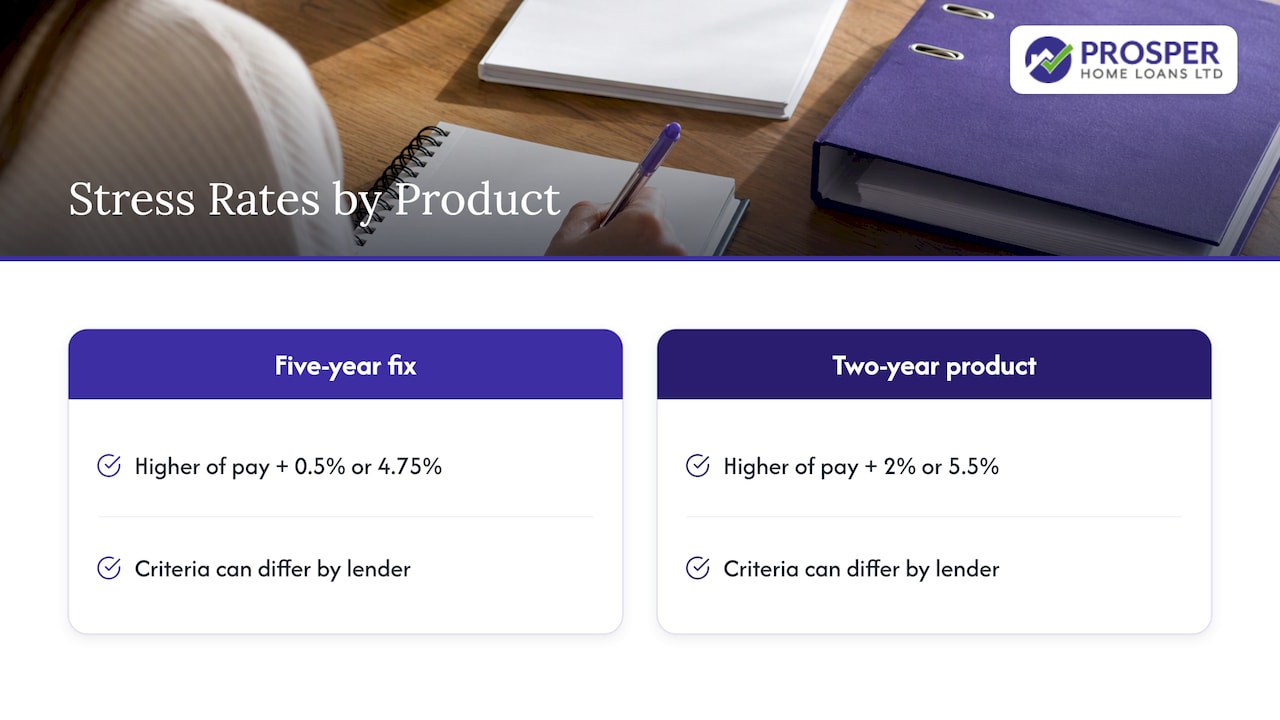
So a five-year fix can mean a lower stress rate, and a bigger loan on the same rent, with lenders that work this way. Rates and stress rates move with the market and lender policy, so treat any figure as a snapshot. If you are coming off a fix, our piece on remortgaging a buy-to-let covers timing.
A worked example
This is our own illustration, not a lender quote. Say a property is expected to rent for £1,000 a month, or £12,000 a year, and the stress rate is 5.5%.
| Tax band | ICR | Rent needed per £1 of stressed interest | Largest interest-only loan the rent supports |
|---|---|---|---|
| Basic rate | 125% | £1.25 | about £174,500 |
| Higher rate | 145% | £1.45 | about £150,400 |
The sums: £12,000 ÷ 1.25 = £9,600 of allowed interest, and £9,600 ÷ 0.055 = £174,545. At 145%, £12,000 ÷ 1.45 = £8,276, and £8,276 ÷ 0.055 = £150,470.
Same rent, same property, a difference of around £24,000 in the loan. Your tax band changes the answer, which is why it pays to check before you offer on a property.
HMO or single let: what changes
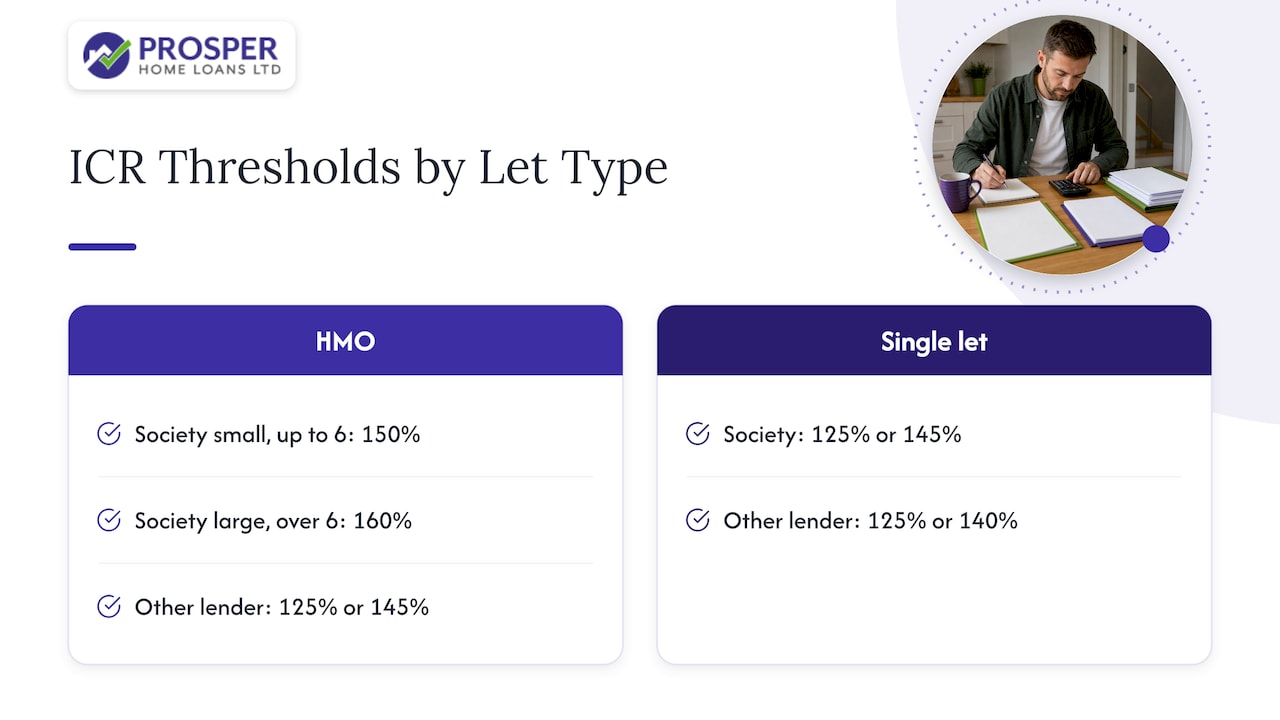
A house in multiple occupation (HMO) is a property let to several tenants who share facilities. Lenders treat it as higher risk. In the building society’s 2026 criteria, a small HMO (up to six occupants) needs a minimum ICR of 150% and a large HMO (more than six) needs 160%, against 125% or 145% for a standard let. Its valuers verify the HMO rent independently, and surplus income is not considered in HMO affordability.
Lenders differ. Another lender’s criteria guide, dated 5 November 2026, lists 125% and 145% for HMOs and 125% and 140% for single lets, using market rental valuations. The lesson is that an HMO can pay more rent but is not always judged on the same terms as a single let, so compare lenders for your property type.
Holiday let or buy-to-let
Holiday lets are usually stressed harder because the income is seasonal. The same building society uses 170% for a holiday let, and works out annual rent by averaging a letting agent’s written high, mid and low seasonal rates over 30 weeks. Its example of £900, £620 and £400 averages £640, giving £19,200 a year. It does not accept limited company applicants for holiday lets.
Another lender’s holiday let criteria (January 2026) take 20% off gross rent for letting agent costs, then ask for 145% of interest at the stated stress rate, with a minimum property value of £150,000. The assessment method is different, so a holiday let can look better or worse on paper than a standard let. It depends on the lender and the numbers.
If the rent falls short
The PRA allows lenders to use personal income to supplement rent, but they must carry out a detailed affordability assessment. That means income after tax and National Insurance, rental income from all properties, essential spending and existing commitments.
This is often called top slicing. One bank’s rental criteria guide (November 2025) allows earned income from up to two applicants to cover a shortfall. It asks for £50,000 single or £75,000 joint income and rent covering at least 100% of the stressed interest. Other lenders set different income minimums.
For self-employed readers, how your income is assessed matters. Some lenders may use gross CIS earnings when assessing affordability, subject to their criteria. That does not raise your actual income and does not guarantee higher borrowing. Directors paid through a company should read our guide on limited company mortgage differences for subcontractors.
Other ways to improve the picture include a smaller loan, a longer fix, a larger deposit or a property with a higher achievable rent. To make sense of a calculator result, see our post on interpreting stress test results.
Our view as brokers
We see the stress test as a planning tool, not a hurdle to be afraid of. Run the numbers before you choose a property, not after you have had an offer accepted.
For self-employed landlords and CIS subcontractors, the lender matters as much as the property. Two lenders can look at the same rent and the same income and reach different answers. Our job is to explain the options, costs and risks clearly and to look across the market for criteria that fit your circumstances, with no promises about approval.
We are local to East Sussex and available to talk through your figures.
Paul McMath CeMAP CeRER
Talk to a local broker
If you are a landlord or a self-employed buyer in Hastings, Eastbourne, Hailsham, Bexhill-on-Sea or elsewhere in East Sussex, we can look at your rent, income and structure and explain which lender criteria may suit you. Our buy-to-let and limited company mortgage advice covers whole-of-market searches, and our CIS subcontractor mortgages page explains how we approach contractor income.

Availability and terms depend on your circumstances and lender criteria. Your property may be repossessed if you do not keep up repayments on a mortgage secured against it.
FAQ
What is a good rental coverage for a buy-to-let?
Most lenders look for 125% for basic-rate taxpayers and 145% for higher-rate taxpayers at their stress rate. HMOs and holiday lets can need more. Published criteria vary, so the right figure depends on the lender and product.
Does the stress test use my actual mortgage rate?
No. It uses a higher stress rate, often with a minimum figure, so the test is harder to pass than your real payments suggest. A longer fixed rate can bring a lower stress rate with some lenders.
Do I need personal income for a buy-to-let mortgage?
Not always, as some lenders rely on rent alone, but many set a minimum income. Where rent is short, some lenders consider your income as well. Check the lender’s criteria for the property type you want.
Is the test the same for a limited company?
Lenders can apply different thresholds to company borrowers, and some do not accept companies for certain lets, such as holiday lets with one building society. A broker can check which lenders accept your structure.
Sources
- PRA SS13/16, underwriting standards for buy-to-let mortgage contracts (January 2026 update)
- Bank of England Quarterly Bulletin 2023, the buy-to-let sector and financial stability
- Building society mortgage lending criteria and guidance 2026
- Bank buy-to-let useful guide, August 2026
- Lender rental cover lending criteria
- Lender buy-to-let criteria guide, November 2026
- Lender holiday let criteria guide, January 2026
- Bank rental criteria guide, November 2025
Recommended
- Buy to Let Minimum Income in the UK: Why £25,000 Often Matters
- Interpret Your Mortgage Stress Test Results Correctly
- Four London Buy to Let Yield Areas, Then the Affordability Check
- Serviced Accommodation Mortgages in the UK: How They Work
This article provides general information and is not a personal mortgage recommendation. Mortgage availability and eligibility depend on your circumstances and lender criteria. Rates and criteria can change. We will explain any applicable fees before you commit. Think carefully before securing other debts against your home. Consolidating debts over a longer term may reduce your monthly payments but increase the total amount you repay. Your home may be repossessed if you do not keep up repayments
